


The Impact of Chronic Pain in Filum Disease (Arnold-Chiari I, Idiopathic Syringomyelia and Idiopathic Scoliosis)
World Day Against Pain is observed on 17 October 2026. This initiative, promoted since 2004 by the International Association for the Study of Pain (IASP) and the World Health Organization (WHO), aims to raise awareness of this issue.
What is pain?
Pain is an unpleasant sensory and emotional experience. The nervous system sends pain signals to alert us that something may be wrong in the body. Pain can be caused by actual or potential tissue damage.
Types of pain
Pain can be classified (1) as follows:
- Acute pain: A rapid response by the nervous system to a harmful stimulus detected by nociceptors.
- Chronic pain: Occurs when the signal is excessively amplified within the central nervous system (CNS), and there is no longer a direct relationship between the initial stimulus and the response.
Pain in Neuro-Cranio-Vertebral Syndrome
Many patients diagnosed with conditions related to acquired Neuro-Cranio-Vertebral Syndrome (NCVS) and congenital Filum Disease (FD) share a common symptom: disabling pain.
Associated conditions include several whose causes remain unknown to conventional medicine:
- Arnold-Chiari I syndrome
- Idiopathic scoliosis and syringomyelia
- Fibromyalgia
- Multiple disc disease
- Coccyx dislocation
These clinical conditions can cause headaches, neck pain, back pain in the thoracic or lumbar region, or pain in the limbs, limiting patients’ daily activities.
Treatment and improved quality of life
Most patients with FD and NCVS experience chronic pain, which reduces their independence and adversely affects their daily lives.
Following treatment with the Filum System®, postoperative follow-up examinations show significant clinical improvement in most patients, with very favourable outcomes in terms of painful symptoms.
Clinical Results: Effectiveness in Reducing Pain
The clinical case series of the medical team led by Dr Miguel B. Royo Salvador at the Institut Chiari & Siringomielia & Escoliosis de Barcelona (ICSEB) supports the benefits of the treatment.
For example, an analysis of a sample of 94 patients with Filum Disease, idiopathic syringomyelia and Arnold-Chiari I syndrome (Fig. 1) showed that the medical follow-up examination carried out one year after surgery revealed a notable reduction in painful symptoms:
- Headache: Improvement in 86% of cases.
- Neck pain: Reduction in 76% of patients.
- Lumbosacral pain (lower back pain): Relief in 68% of the sample.
- Thoracic back pain (mid-back pain): Improvement in 79% of cases.
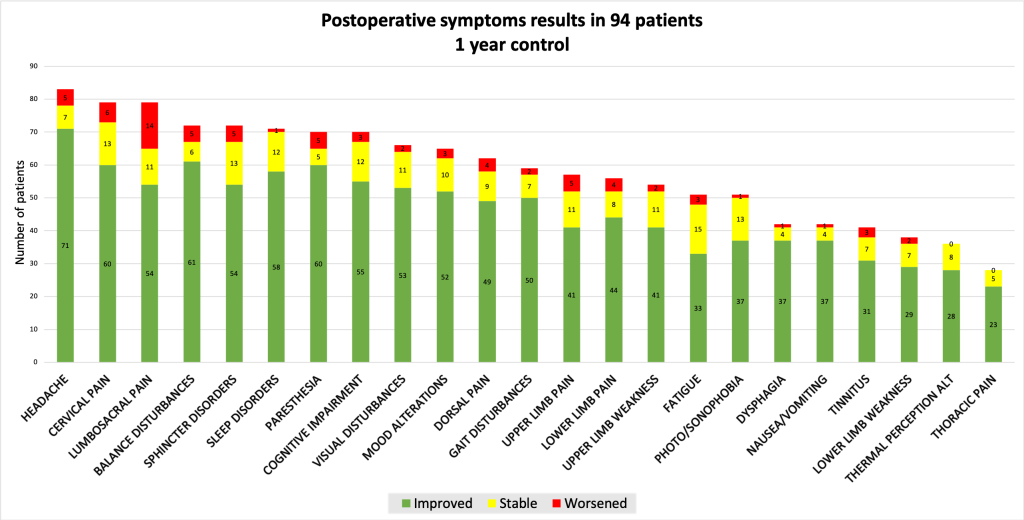
Fig. 1. Graph showing changes in symptoms in 94 patients with Filum Disease and idiopathic syringomyelia who underwent filum terminale section, assessed at the one-year follow-up.
Cutting-Edge Research into the Central Nervous System
Current scientific literature and international medical research are increasingly focused on understanding the physiological changes that occur in chronic pain and lead to a significant increase in nociceptive information transmitted to higher centres of the central nervous system (1).
Similarly, the ICSEB Research and Development Department, which focuses its studies on Filum Disease and NCVS, aims primarily to develop effective therapeutic strategies to improve patients’ quality of life, actively supporting efforts to reduce the chronic and neuropathic pain associated with these conditions.
Postoperative Care with the Filum System®: Reducing Pain to Enable Physiotherapy and Rehabilitation
The relief and reduction of pain, together with the associated physical limitations, that may be achieved through surgical treatment combined with pharmacological treatment can enable patients to return safely to physical activity and specialised physiotherapy.
This postoperative programme is designed to rehabilitate and repair damage to the central nervous system and the rest of the body caused by constant spinal cord traction. By releasing the abnormal tension exerted by the filum terminale before surgery, the Filum System® aims to eliminate the congenital or acquired cause underlying cerebellar tonsillar descent, syringomyelic cavities, spinal curvature and other conditions, with the aim of effectively combating pain.