


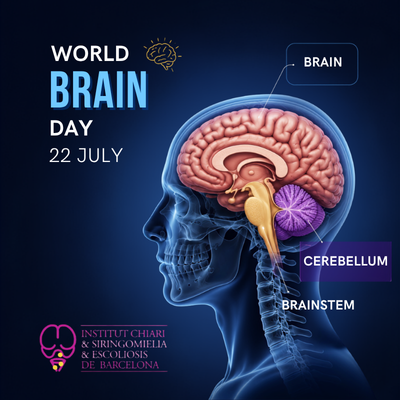
World Brain Day is celebrated every year on 22 July. It is an initiative promoted by the World Federation of Neurology (WFN) since 2014 to raise awareness of the importance of the brain, its functions, the factors that affect its health, and the neurological conditions that can interfere with its normal function.
At our Institute, we are best known for the study and treatment of conditions affecting the brainstem, spinal cord and spine, such as Arnold-Chiari Syndrome Type I, Idiopathic Syringomyelia and Idiopathic Scoliosis. On this day dedicated to brain health, we would also like to highlight that Filum Disease, the common cause of these conditions, may affect the entire Central Nervous System, including the brain.
How does Filum Disease affect the brain?
The abnormal traction exerted by the Filum Terminale on the nervous system can cause changes that affect both the structure and function of the brain. For this reason, many people diagnosed with Filum Disease experience neurological symptoms that originate in, or have an impact on, the brain.
Headaches and migraine in patients with Arnold-Chiari Syndrome Type I
One of the most common symptoms experienced by our patients, particularly those with descent of the cerebellar tonsils associated with Arnold-Chiari Syndrome Type I<, is headache.
The most common characteristics include:
- Pain at the back of the head, in the occipital-cervical region, or in the forehead.
- One-sided migraine attacks accompanied by nausea and vomiting.
- Migraine with or without neurological aura.
Headaches may also be accompanied by:
- Pain behind the eyes.
- Photophobia (sensitivity to light).
- Phonophobia (sensitivity to noise).
- Blurred vision.
- Tinnitus.
- Hearing loss.
- Language difficulties, such as problems finding the right words or speaking clearly.
Headaches can range from mild to disabling. Episodes may last from a few hours to two or three days. In some cases, headaches respond to medication. In others, they may be resistant to conventional treatments.
The frequency also varies. They may occur once a month, once a week or every two weeks.
Sleep disorders associated with Filum Disease
Patients may also experience sleep disorders that can significantly affect their quality of life.
The most common include:
- Difficulty falling asleep.
- Difficulty staying asleep.
- Sleep apnoea.
- Hypersomnia, in a smaller number of cases.
Good quality sleep is essential for brain health and healthy cognitive function.
Mental health, memory and cognitive function
Various studies and clinical observations have shown that Filum Disease, particularly when associated with Arnold-Chiari Syndrome Type I, may affect neuropsychological function.
Reported changes include:
- Mood disorders.
- Cognitive difficulties.
- Problems with attention and concentration.
- Memory problems, particularly affecting anterograde memory.
- Language disorders.
These symptoms can have a significant impact on patients’ daily lives and independence.
Craniovertebral abnormalities associated with Filum Disease
There are also several anatomical abnormalities affecting the base of the skull and the craniovertebral junction that are frequently associated with Arnold-Chiari Syndrome Type I.
These changes may be an expression of Filum Disease, caused by the mechanical conflict that occurs during development.
They include:
- Basilar impression.
- Platybasia.
- Odontoid retroflexion.
These abnormalities may contribute to neurological symptoms and require specialist assessment.
The importance of protecting brain health
The human brain is the most complex organ in the body and the main component of the Central Nervous System.
Its billions of nerve cells regulate essential functions including movement, memory, language, emotions, learning and the control of vital organs.
Looking after brain health is important at every stage of life.
Some recommendations for protecting your brain include:
- Taking regular physical exercise.
- Eating a balanced and nutritious diet.
- Keeping your mind active.
- Getting enough sleep.
- Reducing stress where possible.
- Seeking regular medical assessment if neurological symptoms are present.
Early diagnosis and specialist care
If you experience persistent headaches, sleep disturbances, cognitive difficulties, language problems or any other neurological symptoms, it is advisable to consult a specialist. A thorough assessment can help establish an accurate diagnosis and determine the most appropriate treatment for each individual.
Identifying the underlying cause at an early stage allows personalised treatment strategies to be planned and can help improve patients’ quality of life.
On this World Brain Day 2026, we would like to highlight the importance of understanding, protecting and caring for brain health, while recognising the possible influence of Filum Disease on the entire Central Nervous System.