



On 4 December 2025, Dr Royo Salvador published a scientific poster in the 5th International Webinar on Neuroscience and Psychiatry, at the International Conference on Neuropsychiatry in Paris, on a study carried out with the aim of describing the neuropsychological alterations of patients with Filum Disease, Neuro-Cranio-vertebral Syndrome and related conditions, and of analysing their impact on patients’ quality of life.
The retrospective study describes the clinical anamneses of 372 randomly selected patients with the aforementioned diagnoses, and assesses self-reported psychological–emotional health in a further 34 patients.
The authors highlight in the results that, Filum Disease and related conditions may affect mood, cognitive functions and sexual function, together with physical symptoms such as headaches, pain, instability, lack of sensitivity or strength and paresis (see graphs in Fig. 1). Many patients report that the progression of symptoms worsens the self-perception of physical and psychological health, influencing life expectations.
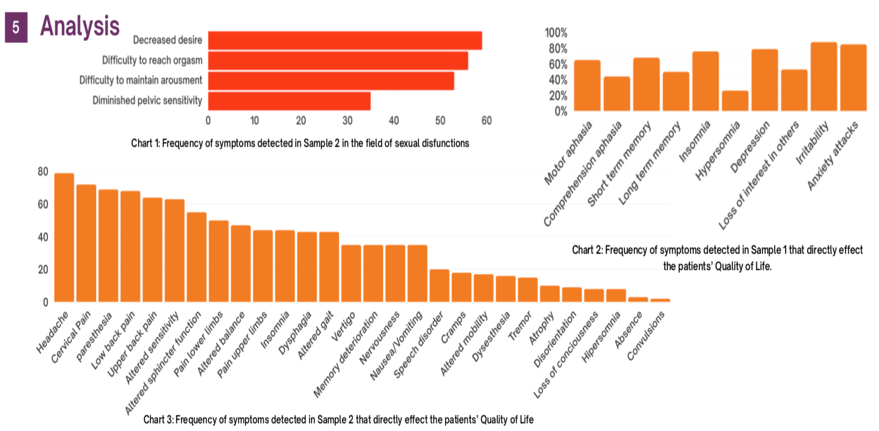
Fig.1 Graphs of the frequency of symptoms in the two samples of clinical cases of the study “Filum Disease and Neuro-Cranio-vertebral Syndrome with Arnold-Chiari Syndrome I, Idiopathic Syringomyelia, Idiopathic Scoliosis: Quality of Life.” M. B. Royo-Salvador, G. Luè, 2025.
The consequences of the associated Neuro-Cranio-vertebral Syndrome, in social and environmental contexts, further reduce quality of life. Physical limitations, neuropsychological discomfort and the progressive nature of the symptoms significantly affect daily life.
In view of the results of the study, all specialists are invited to take into account the aetiological perspective of each of the related conditions, with the aim of understanding the diagnosis and avoiding errors, delays or confusion. This is also intended to ensure the best possible follow-up of the patient during the recovery process after treatment, given the complex and variable clinical picture that characterises caudal traction conveyed throughout the entire nervous system, caused by an excessively tense Filum terminale.
The conclusions of the study indicate that, for diagnosis, prognosis, treatment and postoperative evaluation, it is essential to consider all aspects reported in the initial anamnesis, in order to provide a comprehensive, patient-centred approach and thus achieve a better quality of life for patients with Filum Disease.
The published poster can be downloaded at: https://institutchiaribcn.com/en/international-conference-on-neuropsychiatry-december-03-04-2025-paris/