


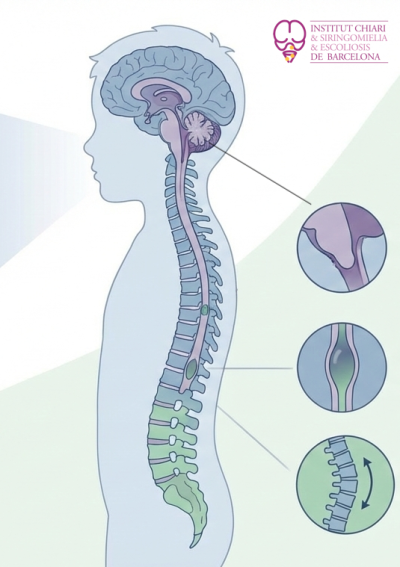
Filum Disease (FD) develops in a unique and individual way in each patient. As it is a congenital condition, it affects the development of the central nervous system and the spine from the embryonic stage, and it may progress gradually throughout the course of life.
Diagnosis
Of the conditions caused by FD, according to what we observe in our case series:
– We know that the descent of the cerebellar tonsils that characterises Arnold–Chiari I Syndrome may evolve from an early age, as it can be present in the first months of life. This can be observed when a Magnetic Resonance Imaging (MRI) is performed during this early period.
– Idiopathic syringomyelia progresses by deteriorating the medullary tissues and may affect each individual in a way that is not directly proportional to the clinical picture: there are cavities extending over many segments of the spinal cord associated with minimal symptomatological manifestations, and small cysts of barely one vertebra in length with complex clinical pictures and lack of autonomy. This is usually discovered on MRIs – by chance – or when a clinical picture exists.
– Idiopathic scoliosis is a lateral deviation of the spinal column which, like kyphosis and hyperlordosis in the anteroposterior plane, and rotoscoliosis in the axial plane, tends to develop progressively during childhood and adolescence, often accentuated by the hormonal changes of puberty. Depending on the symptoms that children present, paediatricians may detect these deviations either during routine check-ups or through examinations due to pain or other symptoms or abnormal postures that may appear with physical activity during growth.
Likewise, in the relatives – especially first-degree relatives – of patients with FD, it is advisable to proceed with complementary examinations, in coordination with their paediatrician, to assess the possible hereditary transmission and detect the presence of these conditions.
Treatment
The Filum terminale is the ligament which, in these conditions, exerts excessive traction to the entire central nervous system and causes different reversible and irreversible lesions in each patient.
The main objective of applying the Filum System® treatment, in addition to refining the diagnosis, is, from surgery onwards, to stop the possible progression of the lesions, together with pharmacological and rehabilitation treatment, and to repair those lesions that are reversible.
For this reason, once the mentioned diagnoses are detected, it is advisable to apply the Filum System® method as soon as possible, especially in younger patients, and even from early childhood, in order to prevent an increase in symptoms that could limit psychomotor function and affect the course of their development.
In our centre, of 2425 patients who underwent the Sectioning of the Filum Terminale by the neurosurgical team led by Dr M. B. Royo Salvador, 4% were children aged 0 to 10 years and 5% were children and adolescents aged between 10 and 16. At present, the youngest patient operated on by our team was 4 months old at the time of treatment.
In children, general anaesthesia is typically administered for safety, and the procedure is performed using a minimally invasive technique, which leaves an incision of a few centimeters in the coccyx area, with minimal risk of infection or haematoma of the surgical wound. On the other hand, those over 16 years of age are considered in the adult patient bracket, and if there are no contraindications, they receive local anaesthesia with sedation. In any case, this assessment will always be carried out following the anaesthetist’s criteria and protocols.
Although most patients are hospitalized for only 24 hours, extra nights may be required if the child still uses nappies, in order to prevent the surgical area from becoming wet or contaminated – with special wound-protection measures for the youngest patients.
Parents or guardians may remainwith the child from admission through to the operating theatre, including induction, recovery and throughout the entire hospital stay. One person may stay overnight with the minor, and more family members may be present during the day for the duration of the hospitalisation.
Results
In more than 30 years of applying the Filum System® to our younger patients (minors), we have observed the same statistical results as in other age groups, achieving the aforementioned objective of halting the progression of Filum Disease. This often brings relief, improvement or disappearance of symptoms, thereby improving the quality of life and autonomy of patients, from early developmental age.
On the other hand, in postoperative periods, we observe changes in some characteristics specific to the developmental age of each young patient, including the recovery of aspects such as the growth curve in the relationship between height and weight, or the cognitive and psychomotor conditions of the patients, and in some cases even behavioural aspects.
You can access the testimonies on our website through the following links, by searching for those from the parents of our young patients:
https://institutchiaribcn.com/en/video-testimonials/
You can also find more information at the following link, where two mothers share their experiences of Arnold–Chiari and the treatment alongside their children: https://youtu.be/p44-SyT_Kjo